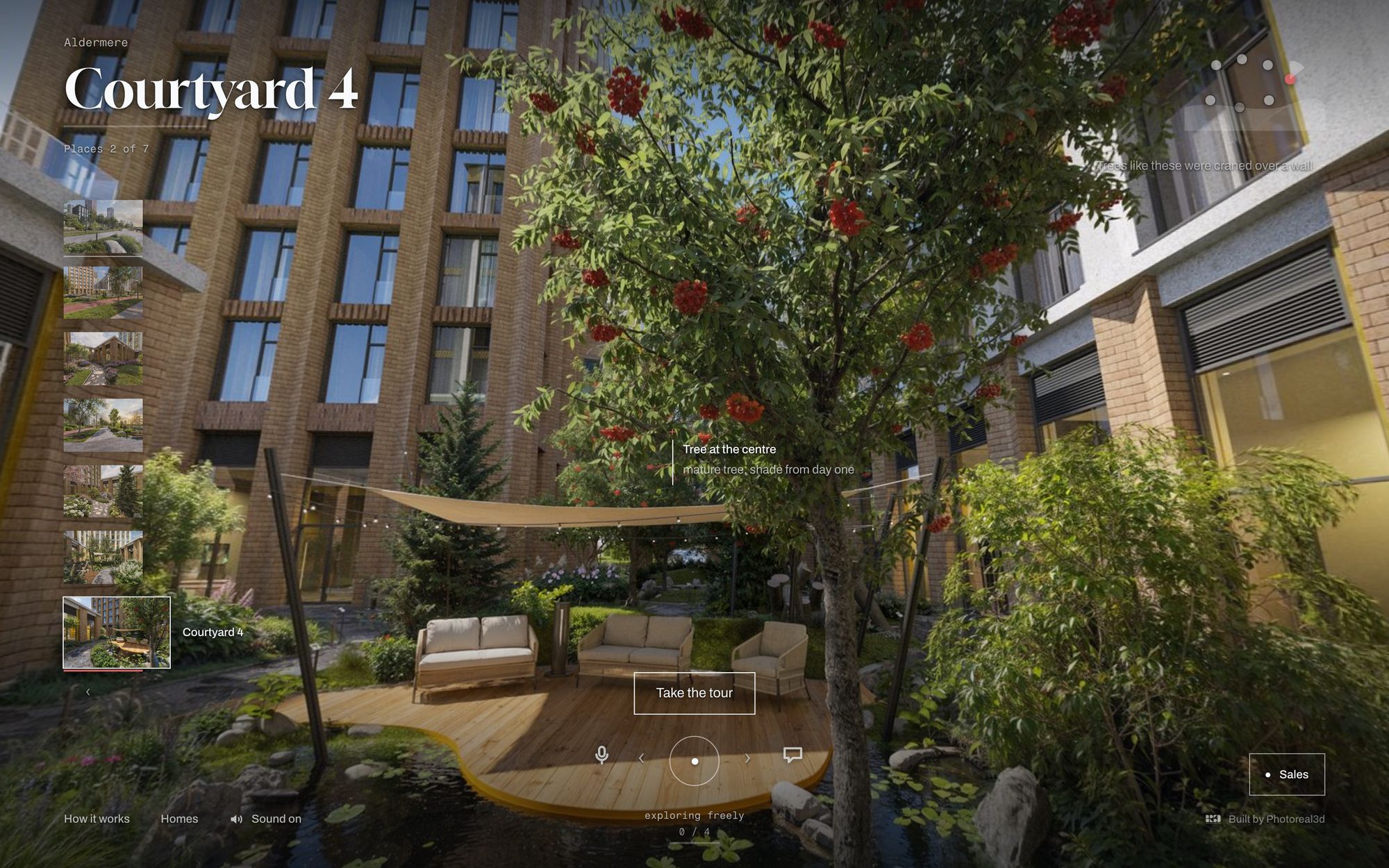
A timber deck over a courtyard pond, with sofas under a sail shade between brick buildings

For developers selling off-plan

Every visitor gets a viewing

A host inside your 3D tour. It walks each buyer round the development, answers their questions in their own words and language, and hands your sales team a lead that arrives already briefed.

Aldermere, courtyard 4 — a render, not a photograph

Most visitors leave without a word

People buying off-plan are usually abroad, usually browsing in their own evening, and rarely ready to hand over a phone number. They walk the tour, a question comes up — is the school open yet, what will be finished by spring, can they bring the dog — and there’s nobody to ask. So they close the tab.

You never learn who they were, what held their attention, or why they went.

The question comes out of hours

Buyers in another time zone browse when your office is shut. The tour stays open; the conversation doesn’t.

A form asks before it gives

Name and number first, answers later. Someone with one small question won’t pay that price.

Every sales call starts cold

When a lead does come through, it’s a name and a number. The first ten minutes go on finding out what the tour could have told you.

Someone to walk them round

The host lives inside the tour, not in a chat window in the corner. It moves the camera, opens the homes catalogue and talks about whatever the visitor is looking at.

It gets to know them first

Who’s moving in, what matters, what’s wrong with where they live now. A conversation rather than a questionnaire — and the answers become a profile.

It takes a different route for each buyer

A family sees the car-free courtyards and the school first. An investor sees the waterfront and what can never be built opposite. The route changes as they talk, and the host says why it’s showing what it shows.

It understands plain speech

“Take me to the courtyard with the pond.” “Compare the 63 and the 81.” The camera moves, the catalogue opens. Ask what something is and the view turns to it while the host answers. Visitors can speak or type in their own language; the recorded walk-through is in English.

It shortlists, and admits the downside

After a few minutes of conversation it picks three homes, says why each one fits and where each one falls short. A shortlist that names its compromises is one people believe.

It knows when to hand over

Reservations, finance, anything binding goes to your team — by phone or message, from anywhere in the tour.

The tour interface in a courtyard: place list on the left, a label beside a tree, controls along the bottom
Labels sit on the render itself, beside the thing they describe. The note top right is background the host keeps to the screen rather than reading aloud.
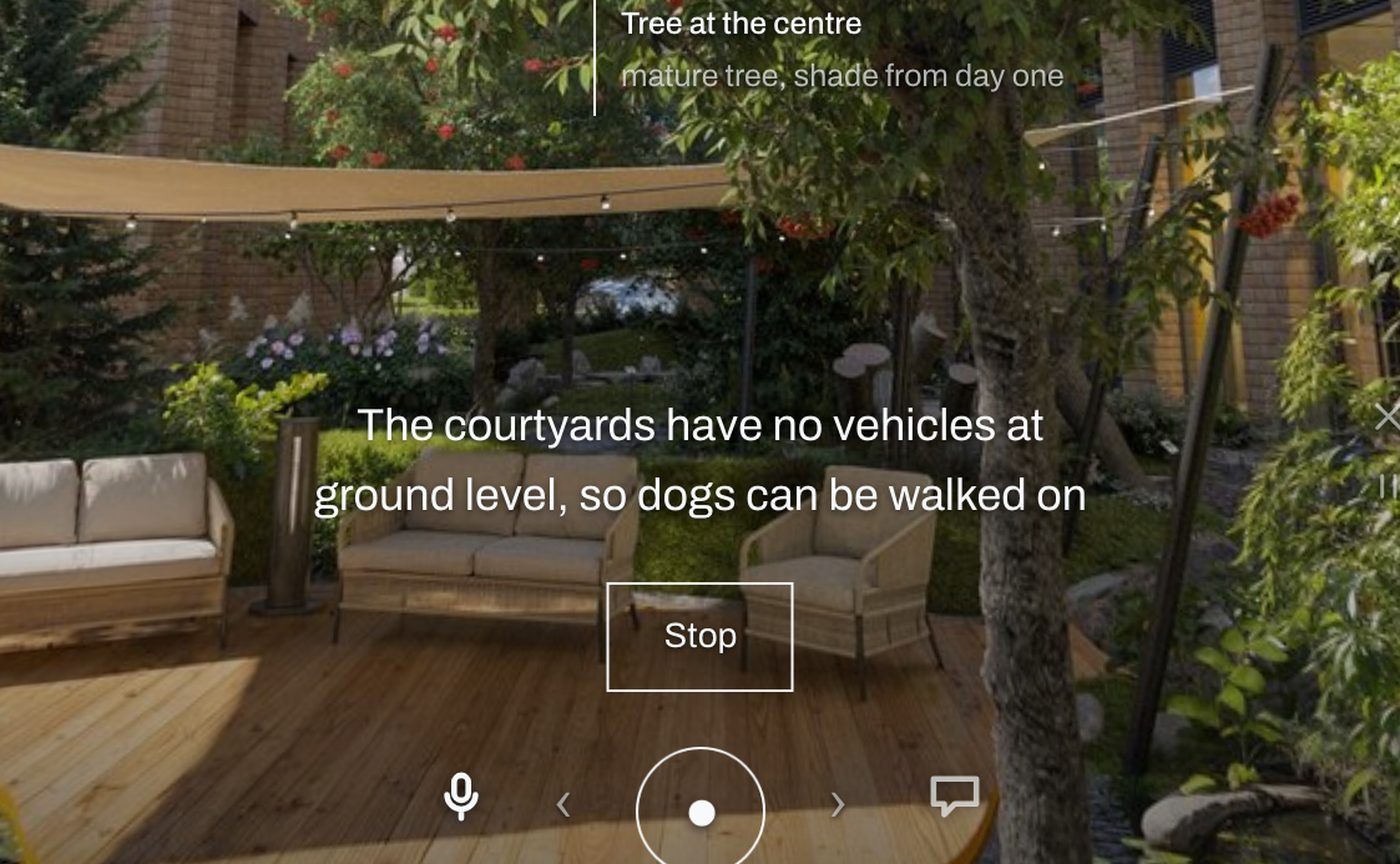
The host’s spoken answer shown as a subtitle over the courtyard deck
Asked out loud: “Can we keep a dog here?”

It won’t promise a pool

Everything the host says comes from a knowledge base you approve: the specification, the amenities, distances on foot, which buildings are finished. When a question falls outside it, the host says so in a sentence and offers your team. It doesn’t guess, and it never claims to be a person.

Prices are a setting. The host can quote from your live price list, or leave money to sales entirely. You decide, project by project.

Is there a pool for residents?

No — there’s no residents’ pool or spa here. The only pool on site is inside the nursery, for the children there.

When will building 5 be finished?

I can’t give a date for that — buildings 5 and 6 are under construction, and that’s as far as my information goes.

Are you a real person?

No, I’m a digital host built into this tour — not a person.

Real answers from the demo — trimmed, not reworded.

The lead arrives already briefed

When a visitor leaves a number, your team gets this with it: what they wanted, where they spent their time, what’s still worrying them, and how to open the first call.

The one below is the system’s own write-up of a test session, word for word. Look at the budget line. Nobody mentioned money, so it doesn’t invent a figure.

score72 / 100
buyerFamily
time in tour17 min · 4 places
shortlistE3-81 · E2-63
contactWhatsApp

brief

A family visitor spent 17 minutes on the tour, almost all of it in the courtyards rather than the waterfront — courtyard one held them over three minutes, the waterfront barely a minute. They asked about the school being open, dogs, a payment plan during construction, and what would be complete by their spring relocation from London. Three apartments viewed, the 63 and 81 compared side by side and both shortlisted. WhatsApp number left. The moving-in question and the payment-plan question both landed outside what I can answer, so they are still open.

budget

  • Unknown — no price discussion took place and none is possible from this session. Family-of-four framing across a 63 and an 81 suggests they are testing the size step rather than working to a fixed ceiling.

signals

  • Left a WhatsApp number unprompted
  • Shortlisted two apartments and ran a direct comparison of E2-63 vs E3-81
  • Asked about a payment plan during construction — finance is on their mind already
  • Concrete relocation trigger: London, spring
  • Asked whether the school is actually open, not whether one exists — checking delivery, not browsing
  • Long dwell in the courtyards, which reads as family-use assessment rather than view-shopping

objections

  • Timing is the live risk: they need to know what is habitable by spring and I could not give dates
  • Payment plan unanswered — if the terms disappoint, the shortlist collapses
  • Low waterfront dwell suggests the river premium may not be what they are paying for; pitch courtyards and school, not views
  • Relocating from a different country — practicalities of buying from abroad were never raised and may surface late
  • Two shortlisted flats in different buildings, so no settled preference yet
The same handover as your CRM receives it
{
  "brief": "A family visitor spent 17 minutes on the tour, almost all of it in the courtyards…",
  "signals": [
    "Left a WhatsApp number unprompted",
    "Shortlisted two apartments and ran a direct comparison of E2-63 vs E3-81",
    "Asked about a payment plan during construction — finance is on their mind already",
    "Concrete relocation trigger: London, spring",
    "Asked whether the school is actually open, not whether one exists — checking delivery, not browsing",
    "Long dwell in the courtyards, which reads as family-use assessment rather than view-shopping"
  ],
  "objections": [
    "Timing is the live risk: they need to know what is habitable by spring and I could not give dates",
    "Payment plan unanswered — if the terms disappoint, the shortlist collapses",
    "Low waterfront dwell suggests the river premium may not be what they are paying for; pitch courtyards and school, not views",
    "Relocating from a different country — practicalities of buying from abroad were never raised and may surface late",
    "Two shortlisted flats in different buildings, so no settled preference yet"
  ],
  "budget_guess": "Unknown — no price discussion took place and none is possible from this session…",
  "score": 72,
  "next_step": "Call on WhatsApp within a day. Lead with what is genuinely complete…"
}
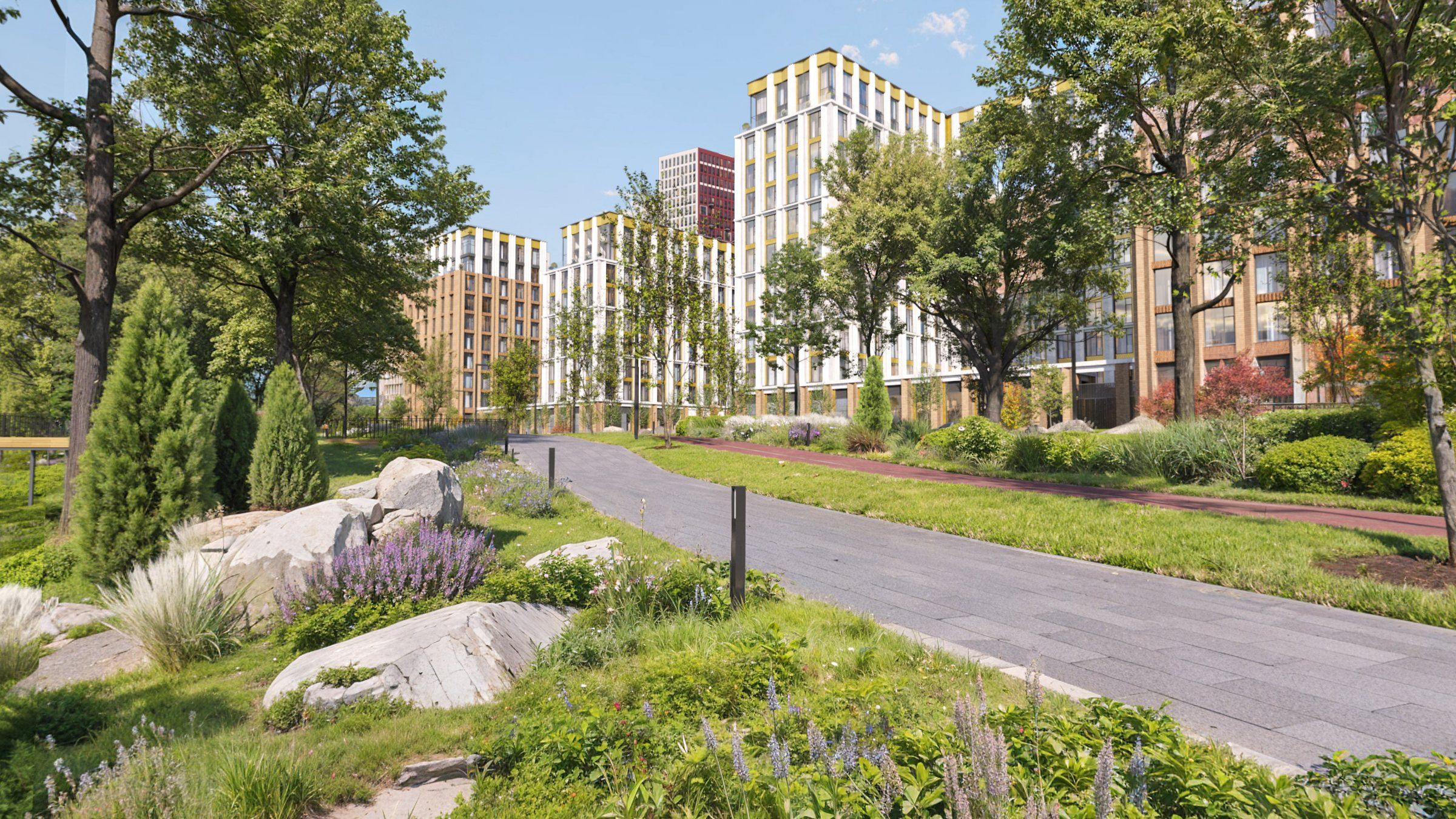
The riverside promenade with the development’s buildings rising behind the trees

Aldermere from the embankment. None of it has been built.

Walkable before the ground is broken

Tours made from scans need a finished building. Website chatbots answer questions with nothing to look at. The host needs neither, because we make the development ourselves: photoreal renders and panoramas built from your drawings.

So buyers can walk it — and talk to someone in it — from the first day of sales, which is when an off-plan project needs it most. The imagery and the host come from one studio, to one standard.

What buyers actually look at

Every visit leaves a record your marketing team has never had: questions in the buyer’s own words, the route they took and where they lingered, the homes they opened and compared.

working today

Questions, word for word
How buyers really phrase demand — ready-made copy for ads and FAQs.
Route and dwell time
Which places hold people and which they skip, inside every handover.
A scored brief for each contact
Signals, objections and the next step, as above.

in build

Attention across all visits
A heat map of what the whole audience looks at, place by place.
Straight into your CRM
The lead and its brief land in the pipeline the moment a contact is left.
Memory between visits
A returning buyer is met where they left off.
Agent-led viewings
Your agent steers the tour on a call; the buyer sees the same view.

Built so nothing surprises you

The walk-through itself is a script. Every scripted line is written, approved and recorded in advance, so it plays instantly and says exactly what you signed off. The language model only steps in where a visitor speaks in their own words — and even then it answers from your knowledge base, not from the internet.

The panoramas run on our own viewer, not a third-party tour platform, so there are no per-view fees and nothing to embed from someone else. The tour sits on your domain.

From renders to a working host in four weeks

week 1Content

Panoramas and renders — ours, or yours if they already exist. Points of interest marked up in the frame. The knowledge base drafted from your documents.

week 2Script and voice

The walk-through and a route for each kind of buyer. The homes catalogue with plans. A voice chosen and every scripted line recorded.

week 3Integration

Your CRM, the tour on your own domain, and a line-by-line sign-off of everything the host is allowed to say.

week 4Launch

We walk it with your sales team, then hand over the routine for keeping facts and prices current.

What we need from you: the price list, floor plans, the project facts and access to your CRM. If we’re already producing your visualisation, the content is done.

Ask it something yourself

Walk the courtyards. Ask about the school out loud, or ask for a shortlist. Then come back here and look at what your sales team would have been sent.